Art of Public Speaking Wconnect Clg of Southern Nv Edition 12th

The orator Cicero speaks to the Roman Senate.
Cicero Denounces Catiline (1889), fresco past Cesare Maccari
Public speaking, also called oratory or oration, has traditionally meant the act of speaking face to face to a live audience. Today it includes any course of speaking (formally and informally) to an audience, including pre-recorded speech delivered over great distance past means of technology.
Confucius, ane of many scholars associated with public speaking, once taught that if a speech was considered to be a good spoken language, it would impact the individuals' lives whether they listened to it directly or not.[1] His idea was that the words and actions of someone of power can influence the world.[i]
Public speaking is used for many different purposes, but usually some mixture of education, persuasion, or entertaining. Each of these calls upon slightly unlike approaches and techniques.
Public speaking has developed as a chief sphere of knowledge in Hellenic republic and Rome, where prominent thinkers codified information technology every bit a central part of rhetoric. Today, the art of public speaking has been transformed by newly bachelor technology such as videoconferencing, multimedia presentations, and other nontraditional forms, only the essentials remain the same.
Purpose of public speaking [edit]
The function of public speaking depends entirely on what effect a speaker intends when addressing a particular audition. The same speaker, with the same strategic intention, might deliver a substantially different speech to two different audiences. The point is to change something, in the hearts, minds, or actions of the audience.
Despite its name, public speaking is frequently delivered to a closed, express audition with a broadly common outlook. Audiences may be ardent fans of the speaker; they may be hostile (attending an event unwillingly, or out of spite), or they may be random strangers (indifferent to a speaker on a soapbox in the street). All the aforementioned, effective speakers think that even a small audience is not ane unmarried mass with a unmarried point of view but a variety of individuals.[two]
As a broad generalization, public speaking seeks either to reassure a troubled audience, or to awaken a complacent audience to something of import. Having decided which of these approaches is needed, a speaker will then combine information and storytelling in the mode almost likely to achieve it.
Persuasion [edit]
The word persuasion comes from a Latin term "persuadere."[3] The main goal backside a persuasive oral communication is to change the beliefs of a speaker's audition.[3] Examples of persuasive speaking can be found in whatsoever political debate where leaders are trying to persuade their audition, whether it be the general public, or members of the government.[3]
Persuasive speaking tin can be defined as a style of speaking in which there are four parts to the process: the one who is persuading, the audition, the method in which the speaker uses to speak, and the bulletin that the speaker is trying to enforce.[iii] When trying to persuade an audience, a speaker targets the audience's feelings and beliefs, to assist modify the opinions of the audience.[iii]
At that place are dissimilar techniques a speaker can utilise to gain the support of an audience.[3] Some of the major techniques would include demanding the audience to have action, using inclusive language ('we' & 'united states') to make the audition and speaker seem as if they are one group, and choosing specific words that accept a strong connotative meaning increasing the impact of the bulletin.[3] Request rhetorical questions, generalizing data (including anecdotes), exaggerating significant, using metaphors, and applying irony to situations are other methods in which a speaker tin can heighten the chances of persuading an audience.[3]
Didactics [edit]
Cognition may be transferred through public speaking. A pop example of educational public speaking is TEDTalks, where the speaker will inform listeners nigh diverse topics, such every bit scientific discipline, physics, biology, technology, organized religion, economic science, human society, astronomy, creature studies, psychology, and many others. TED speakers also share their personal experiences with traumatic life events, such as abuse, bullying, grief, assault, suicidal ideation and/or attempts, well-nigh death experiences, and mental illness, or utilize their platform to raise awareness and acceptance for disabilities, facial differences, LGBT rights, women'south rights, and stigmatized life circumstances.
Intervention [edit]
The intervention style of speaking is a relatively new method proposed by a rhetorical theorist named William R. Brown.[four] This style revolves around the fact that humans create a symbolic significant for life and the things we interact with around them.[4] Due to this, the symbolic pregnant of everything changes based on the way we communicate.[4] When approaching advice with an intervention style, advice is understood to be responsible for the abiding changes in our gild, behaviors, and how we consider the pregnant behind objects, ideologies, and every day life.[iv]
From an interventional perspective, when individuals communicate, they are intervening with what is already a reality and might "shift symbolic reality."[iv] This approach to communication also encompasses the possibility or idea that nosotros may be responsible for unexpected outcomes due to what and how nosotros communicate.[iv] This perspective too widens the telescopic of focus from a unmarried speaker who is intervening to a multitude of speakers all communicating and intervening, simultaneously affecting the world around us.[4]
History [edit]
Hellenic republic [edit]
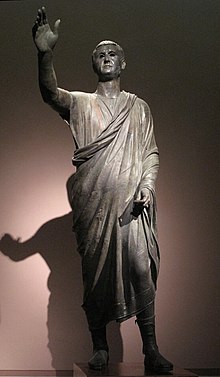
Although there is evidence of public speech training in ancient Egypt,[five] the showtime known piece[six] on oratory, written over 2,000 years ago, came from ancient Greece. This work elaborated on principles drawn from the practices and experiences of ancient Greek orators.
Aristotle was ane who start recorded the teachers of oratory to use definitive rules and models. One of his key insights was that speakers always combine, to varying degrees, three things: reasoning, credentials, and emotion, which he chosen Logos, Ethos, and Pathos.[7] Aristotle's work became an essential part of a liberal arts education during the Heart Ages and the Renaissance. The classical antiquity works written by the ancient Greeks capture the ways they taught and adult the art of public speaking thousands of years ago.
In classical Greece and Rome, rhetoric was the main component of limerick and speech delivery, both of which were critical skills for citizens to use in public and individual life. In aboriginal Greece, citizens spoke on their ain behalf rather than having professionals, like modern lawyers, speak for them. Whatsoever citizen who wished to succeed in court, in politics, or in social life had to learn techniques of public speaking. Rhetorical tools were kickoff taught by a group of rhetoric teachers chosen Sophists who were notable for education paying students how to speak finer using the methods they adult.
Separately from the Sophists, Socrates, Plato, and Aristotle developed their own theories of public speaking and taught these principles to students who wanted to learn skills in rhetoric. Plato and Aristotle taught these principles in schools that they founded, The Academy and The Lyceum, respectively. Although Greece eventually lost political sovereignty, the Greek civilization of training in public speaking was adopted almost identically by the Romans.
Demosthenes was a well-known orator from Athens. After his father died when he was 7, he had 3 legal guardians which were Aphobus, Demophon, and Theryppides.[8] His inspiration for public speaking came after he learned that his guardians had robbed his father'due south money left for his educational activity.[9] He was showtime exposed to public speaking when his suit required him to speak in front of the courtroom.[10] Demosthenes started practicing public speaking more after that and is known for sticking pebbles into his mouth in order to aid his pronunciation, talk while running and then that he wouldn't lose his jiff while speaking, and practise talking in front of a mirror to amend his delivery.[ten] When Philip II, the ruler of Macedon, tried to conquer the Greeks, Demosthenes made a speech called Kata Philippou A. [8] In this spoken communication, he spoke to the residuum of the Greeks nearly why he opposed Philip II and why he was a threat to them.[viii] This spoken communication was one of the first speeches that were known every bit Philippics.[10] He had other speeches known every bit Olynthiacs and these speeches along with the Philippics were used to get the people in Athens to rally against Philip II.[10] Demosthenes was known for existence in favor of independence.[nine]
Rome [edit]
In the political rise of the Roman Republic, Roman orators copied and modified the ancient Greek techniques of public speaking. Didactics in rhetoric developed into a total curriculum, including instruction in grammar (study of the poets), preliminary exercises (progymnasmata), and preparation of public speeches (declamation) in both forensic and deliberative genres.
The Latin style of rhetoric was heavily influenced by Cicero and involved a strong emphasis on a broad education in all areas of humanistic study in the liberal arts, including philosophy. Other areas of study included the employ of wit and sense of humor, the appeal to the listener's emotions, and the use of digressions. Oratory in the Roman empire, though less key to political life than in the days of the Democracy, remained meaning in police force and became a big form of amusement. Famous orators became like celebrities in aboriginal Rome—very wealthy and prominent members of lodge.
The Latin style was the main form of oration until the beginning of the 20th century. Afterward World War 2, even so, the Latin way of oration began to gradually abound out of style as the trend of ornate speaking was seen as impractical. This cultural change probable had to exercise with the rise of the scientific method and the emphasis on a "plain" style of speaking and writing. Even formal oratory is much less ornate today than it was in the Classical Era.
China [edit]
Ancient Prc had a delayed start to the implementation of Rhetoric (persuasion) every bit China did non take rhetoricians teaching rhetoric to its people.[1] It was understood that Chinese rhetoric was already within Chinese philosophy.[1] However, aboriginal China did accept philosophical schools that focused on two concepts: "'Wen' (rhetoric) and 'Zhi' (thoughtful content)."[1] Aboriginal Chinese rhetoric shows stiff connections with modern-day teachings of public speaking because of ideals being of loftier value in Chinese rhetoric.[1]
Ancient Chinese rhetoric had iii meanings: modifying language use to reflect people'south feelings; modifying the language used to be more punctual, effective, and impactful; and rhetoric being used as an "aesthetic tool."[1] Traditionally, Chinese rhetoric focused primarily on written language vice spoken, merely written language and spoken language share like constructional characteristics.[1]
The unique and key deviation between Chinese rhetoric and the rhetoric of western cultures tin can be constitute in the type of audition being persuaded.[one] In western rhetoric, a public audience is typically the target for persuasion, whereas state rulers were the focus for persuasion in Chinese rhetoric.[1] Another deviation between Chinese and Western rhetoric practices is how a speaker establishes credibility or Ethos.[1] The ethical appeal in Chinese rhetoric is not solely focused on the speaker itself, as seen with the western implementation of brownie, but more in the manner that the speaker connects to the audience with collectivism.[1] A speaker can accomplish this by sharing personal experiences and establishing a connectedness betwixt a speaker's concern and public interest.[ane]
When analyzing public speakers, the Chinese approach to rhetoric indicates that an audition should identify iii standards: tracing, examination, and exercise.[1] Establishing the tracing of a speaker can exist described as how the speaker is speaking co-ordinate to traditional practices of spoken communication.[1] Test refers to the consideration of civilian's daily lives.[one] Do is found in the topic or argument itself and that it is relevant and benefits the "state, society, and people."[1]
Theorists [edit]
Aristotle [edit]
Aristotle and i of his near famous writings, "Rhetoric" (written in 350 B.C.E), take been used equally a foundation for learning how to master the arts of public speaking. In his works, rhetoric is the act of publicly persuading the audience.[11] Rhetoric is similar to dialect in that he defines both being acts of persuasion. However, dialect is the act of persuading someone in private, whereas rhetoric is about persuading people in a public setting.[11] More specifically, Aristotle defines someone who practices rhetoric or a "rhetorician" as an private who is able to interpret and empathise what persuasion is and how information technology is practical.[xi]
Aristotle breaks up the making of the practice of rhetoric into three categories, the categories being the elements of a spoken language: the speaker, the topic or point of the speech, and the audition.[eleven] [12] Aristotle besides includes three types of oratory or respects: politics, forensic, and ceremonial.[12] The political oratory is used when the intent is to convince someone or a trunk of people to practice something or non.[12] In the forensic approach, someone is the center of attending for them to be accused or defended. Lastly, with the formalism approach, someone is being recognized for their actions in either a positive or negative way.[12]
Aristotle breaks down the political category into five focus or themes: "ways and ways, war and peace, national defense, imports and exports, and legislation."[12] These focuses are broken down into detail and so that a speaker can focus on what is needed to take into consideration and so that the speaker can effectively influence an audience to hold and back up the speaker's ideas.[12] The focus of "means and means" deals with economic aspects in how the country is spending money.[12] "Peace and War" focus on what the country has to offer in terms of military ability, how war has been conducted, how war has affected the land in the past, and how other countries take conducted war.[12] "National defense force" deals with taking into consideration the position and strength of a country in the event of an invasion. Forces, fortifying structures, points with a strategic reward should all be considered.[12] "Food supply" is concerned with the power to support a country in regards to nutrient, importing and exporting nutrient, and carefully making decisions to arrange agreements with other countries.[12] Lastly, Aristotle breaks downwardly the "legislation" theme, and this theme seems to be the most of import to Aristotle. The legislation of a country is the almost crucial aspect of all the higher up because everything is afflicted past the policies and laws set by the people in power.[12]
In Aristotle's "Rhetoric" writing, he mentions three strategies someone can use to effort to persuade an audience:[xi] Establishing the character of a speaker (Ethos), influencing the emotional element of the audience (Pathos), and focusing on the argument specifically (Logos).[11] [thirteen] Aristotle believes establishing the character of a speaker is effective in persuasion because the audience volition believe what the speaker is proverb to be true if the speaker is credible and trustworthy.[11] With the audience's emotional country, Aristotle believes that individuals practice not make the aforementioned decisions when in different moods.[11] Considering of this, one needs to effort to influence the audience by being in control of 1's emotions, making persuasion effective.[eleven] The argument itself can impact the attempt to persuade by making the statement of the instance so clear and valid that the audience will empathise and believe that the speaker's signal is existent.[11]
In the last role of "Rhetoric", Aristotle mentions that the most critical slice of persuasion is to know in detail what makes upwardly government and to set on what makes it unique: "community, institutions, and interest".[12] Aristotle also states that everyone is persuaded by considering people's interests and how the society in which they live influences their interests.[12]
Historical speeches [edit]
Despite the shift in style, the best-known examples of strong public speaking are still studied years after their delivery. Among these examples are:
- Pericles' Funeral Oration in 427 BC addressing those who died during the Peloponnesian State of war
- Abraham Lincoln's Gettysburg Address in 1863
- Sojourner Truth'south identification of racial bug in "Ain't I a Woman?"
- Martin Luther Rex, Jr.'s "I Have a Dream" speech at the Washington Monument in 1963.[14]
As in other parts of full general culture, the notion of a canon of the most important historical speeches is giving mode to a broader agreement. Many previously forgotten historical speeches are beingness recovered and studied.[xv]
Women and public speaking [edit]
Between the 18th and 19th century in the United States, women were publicly banned from speaking in the courtroom, the senate flooring, and the pulpit.[sixteen] [ pages needed ] It was also deemed improper for a adult female to be heard in a public setting. Exceptions existed for women from the Quaker religion, allowing them speak publicly in meetings of the church.[17] [ pages needed ]
Frances Wright was one of the first female public speakers of the United states, advocating equal education for both women and men through large audiences and the printing.[sixteen] [ pages needed ] Maria Stewart, a woman of African American descent, was also ane of the first female person speakers of the United states, lecturing in Boston in front end of both men and women just 4 years after Wright, in 1832 and 1833, on educational opportunities and abolition for immature girls.[17] [ pages needed ]
The beginning female person agents, and sisters, of the American Anti-Slavery Social club, Angelina Grimké and Sarah Grimké created a platform for public lectures to women, and conducted tours between 1837 and 1839. The sisters advocated how slavery relates to women'due south rights, and why women need equality[18] post-obit disagreement with churches that did not hold with the two speaking publically, due to them being women.[xix]
In addition to figures in the Us, at that place are many international female speakers. Much of women'southward before public speaking is directly correlated to activism work. Emmeline Pankhurst, who was a British political activist, founded the Women'south Social and Political Union (WSPU) on October ten, 1903.[20] The system was aimed towards fighting for a woman'south right for parliamentary vote, which only men were granted for at the fourth dimension.[21] Emmeline was known for beingness a powerful orator, who led many women to insubordinate through militant forms until the outbreak of World War I in 1914.[xx]
Malala Yousafzai is a modern-day public speaker, who was born in the Swat Valley in Pakistan, and is an educational activist for women and girls.[22] Afterward the Taliban restricted the educational rights of women in the Swat Valley, Yousafzai presented her first speech How Dare the Taliban Take Away My Bones Right to Education?, in which she protested the shutdowns of the schools.[23] She presented this oral communication to a printing in Peshawar.[23] Through this, she was able to bring more sensation to the situation in Pakistan.[23] She is known for her "inspiring and passionate speech" virtually educational rights given at the United Nations.[22] She is the youngest person ever to receive the Nobel Peace Prize, which was awarded to her in 2014.[22] Her public speaking has brought worldwide attention to the difficulties of young girls in Pakistan. She continues to advocate for educational rights for women and girls worldwide through the Malala Fund[22], with the purpose of helping girls around the world receive 12 years of education.[23]
Kishida Toshiko (1861-1901) was a female speaker during the Japanese Meiji Period. In Oct 1883, she publicly delivered a speech entitled 'Hakoiri Musume' (Daughters Kept in Boxes) in front end of approximately 600 people.[24] Performed in Yotsu no Miya Theater in Kyoto, she criticised the action of parents that shelter their daughters from the outside world. Despite her prompt arrest, Kishida demonstrates the power for Japanese women to evoke women'southward issues, experience, and liberation in public spaces, through the utilise of public speaking. [25]
Glossophobia [edit]
The fear of speaking in public, known as glossophobia[26] or public speaking anxiety,[27] is oft mentioned as one of the virtually common phobias.[26] [27]
The reason is uncertain, but it has been speculated that this fear is central, like how animals fearfulness being seen by predators.[28]
Nevertheless, the anticipation experienced when speaking in public tin have a number of causes [26] [27], such equally social anxiety disorder, or a prior feel of public humiliation.
Training [edit]
Constructive public speaking can be developed past joining a social club such as Rostrum, Toastmasters International, Association of Speakers Clubs (ASC), or Speaking Circles, in which members are assigned exercises to improve their speaking skills. Members acquire by observation, and practice and strop their skills by listening to effective suggestions, followed by new public speaking exercises.
Toastmasters International
Toastmasters International is a public speaking organization with over fifteen,000 clubs worldwide, and more than 300,000 members.[29] This organization helps individuals with their public speaking skills, as well as other skills necessary for them to grow and become constructive public speakers.[30] Members of the guild meet and work together on their skills; each member practices giving speeches, while the other members evaluate and provide feedback.[30] At that place are besides other small tasks that the members practise, like practice impromptu speaking past talking most unlike topics without having anything planned.[30] Each fellow member has a specific role, and all of these roles help with the procedure of gaining their skills as public speakers, and as leaders.[30] The number of roles lets each fellow member be able to speak at least one time at the meetings.[29] Members are also able to participate in a variety of spoken communication contests, in which the winners can compete in the World Championship of Public Speaking.[31]
Rostrum
Rostrum is another public speaking organization, founded in Australia, with more than 100 clubs all over the country.[32] This organization aims at helping people become better communicators, no affair the occasion.[32] At the meetings, speakers are able to proceeds skills past presenting speeches, while members provide feedback to those presenting.[33] Qualified speaking trainers attend these meetings every bit well, and provide professional feedback at the cease of the meetings.[33] There are also competitions that are held for members to participate in.[32] An online lodge is also bachelor for members, no matter where they live.[34]
The new millennium has seen a notable increase in the number of preparation solutions, offered in the form of video and online courses. Videos can provide simulated examples of behaviors to emulate. Professional public speakers often engage in ongoing grooming and teaching to refine their craft. This may include seeking guidance to ameliorate their speaking skills, such as learning better storytelling techniques, learning how to effectively use humor as a communication tool, and continuously researching in their topic area of focus.[ commendation needed ]
Professional speakers [edit]
Public speaking for business and commercial events is often done by professionals, whose expertise is well established. These speakers can be contracted independently, through representation by a speakers bureau, or by other means. Public speaking plays a large role in the professional person world. In fact, it is believed that seventy percent of all jobs involve some class of public speaking.[35]
Modern [edit]
Technology [edit]
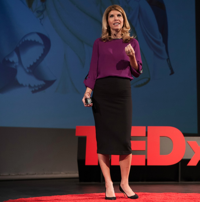
New technology has as well opened different forms of public speaking that are nontraditional such as TED Talks, which are conferences that are broadcast globally. This grade of public speaking has created a wider audition base because public speaking can now reach both physical and virtual audiences.[36] These audiences tin can be watching from all around the world. YouTube is another platform that allows public speaking to reach a larger audition. On YouTube, people can post videos of themselves. Audiences are able to scout these videos for all types of purposes.[37]
Multimedia presentations tin contain different video clips, sound furnishings, animation, laser pointers, remote command clickers, and countless bullet points.[38] All adding to the presentation and evolving our traditional views of public speaking.
Public speakers may use audience response systems. For large assemblies, the speaker volition usually speak with the assistance of a public address system or microphone and loudspeaker.
These new forms of public speaking, which can exist considered nontraditional, have opened up debates about whether these forms of public speaking are really public speaking. Many people consider YouTube dissemination to not be truthful form of public speaking because at that place is non a real and concrete audition. Others argue that public speaking is about getting a group of people together in order to educate them further regardless of how or where the audience is located[ citation needed ].
Telecommunication [edit]
Telecommunication and videoconferencing are also forms of public speaking. David M. Fetterman of Stanford University wrote in his 1997 article Videoconferencing over the Internet: "Videoconferencing technology allows geographically disparate parties to hear and run across each other normally through satellite or telephone advice systems." This technology is helpful for large conference meetings and contiguous communication between parties without enervating the inconvenience of travel.
Notable modernistic theorists [edit]
- Harold Lasswell developed Lasswell's model of communication. In that location are v basic elements of public speaking that are described in this theory: the communicator, message, medium, audience, and effect. In short, the speaker should exist answering the question "who says what in which channel to whom with what effect?"
Run across too [edit]
- Audition response
- Crowd manipulation
- Debate
- Eloquence
- Eulogy
- Glossophobia
- List of speeches
- Public orator
- Persuasion
- Rhetoric
- Speechwriter
- Speakers' bureau
- Thematic interpretation
- Toastmasters International
References [edit]
- ^ a b c d east f thousand h i j k fifty m n o p q Pei-Ling, Lee (October 2020). "The Application of Chinese Rhetoric to Public Speaking". China Media Research. sixteen (four).
- ^ Flintoff, John-Paul (2021). A Pocket-sized Book About How To Make An Adequate Speech. Curt Books. p. 52. ISBN978-1780724560.
An audience is not a unmarried entity, but a group of individuals who differ from one another perchance every bit much equally they may differ from you lot. If y'all forget that, the slip is unlikely to work in your favor.
- ^ a b c d east f 1000 h Hassan Sallomi, Azhar (2018-01-01). "A STYLISTIC Written report OF PERSUASIVE TECHNIQUES IN POLITICAL DISCOURSE". International Journal of Language Academy. 6 (23): 357–365. doi:10.18033/ijla.3912. ISSN 2342-0251.
- ^ a b c d e f g Opt, Susan G. (September 2019). ""To Arbitrate: A Transcending and Reorienting Goal for Public Speaking."". Atlantic Journal of Communication. 27 (4): 247–259. doi:10.1080/15456870.2019.1613657. S2CID 181424112.
- ^ Womack, Morris M.; Bernstein, Elinor (1990). Speech for Foreign Students. Springfield, IL: C.C. Thomas. p. 140. ISBN978-0-398-05699-5 . Retrieved June 12, 2017.
Some of the primeval written records of preparation in public speaking may be traced to aboriginal Egypt. However, the near significant records are found among the ancient Greeks.
- ^ Spud, James J. "Demosthenes – greatest Greek orator". Encyclopædia Britannica.
- ^ Heinrichs, Jay. (2008). Thank you For Arguing. Penguin. p. 39. ISBN978-0593237380.
Aristotle called them logos, ethos, and pathos, then will I, considering the meanings of the Greek versions are richer than those of the English versions
- ^ a b c May, James (2004). "Demosthenes". Salem Printing. Great Lives from History: The Ancient World, Prehistory-476 c.e. Retrieved December 12, 2020.
- ^ a b "Demosthenes (Greek orator) | World History: A Comprehensive Reference Set - Credo Reference". search.credoreference.com . Retrieved 2020-12-13 .
- ^ a b c d "Gale Power Search - Document - Demosthenes & Cicero". go.gale.com . Retrieved 2020-12-xiii .
- ^ a b c d e f g h i j Rapp, Christof. "Aristotle'south Rhetoric". plato.stanford.edu . Retrieved 2021-08-06 .
- ^ a b c d e f yard h i j k l m Roberts, Rhys, translator. ""The Internet Classics Annal | Rhetoric past Aristotle."". The Internet Classics Archive: 441 Searchable Works of Classical Literature . Retrieved 1 July 2021. CS1 maint: url-condition (link)
- ^ Higgins, Colin; Walker, Robyn (September 2012). "Ethos , logos , pathos : Strategies of persuasion in social/environmental reports". Accounting Forum. 36 (3): 194–208. doi:10.1016/j.accfor.2012.02.003. ISSN 0155-9982. S2CID 144894570.
- ^ German, Kathleen M. (2010). Principles of Public Speaking. Boston: Allyn & Bacon. p. six. ISBN 978-0-205-65396-6.
- ^ "Archives of Women's Political Communication". awpc.cattcenter.iastate.edu.
- ^ a b Mankiller, Wilma Pearl (1998). The Reader'due south Companion to U.Due south. Women'due south History . ISBN978-0585068473.
- ^ a b O'Dea, Suzanne (2013). From Suffrage to the Senate: America's Political Women. ISBN978-1-61925-010-ix.
- ^ Bizzell, Patricia (2010). "Chastity Warrants for Women Public Speakers in Nineteenth-Century American Fiction". Rhetoric Society Quarterly. 40 (4): 17. doi:10.1080/02773945.2010.501050. S2CID 143052545.
- ^ Bahdwar, Neera. "Sarah Grimké and Angelina Grimké Weld: Abolitionists and Feminists". The Hereafter of Freedom Foundation. FFF. Retrieved 28 September 2020.
- ^ a b "Gale eBooks - Certificate - Pankhurst, Emmeline, Christabel, and Sylvia". link.gale.com . Retrieved 2020-12-13 .
- ^ Purvis, June (2013), Gottlieb, Julie V.; Toye, Richard (eds.), "Emmeline Pankhurst in the Aftermath of Suffrage, 1918–1928", The Backwash of Suffrage: Women, Gender, and Politics in Britain, 1918–1945, London: Palgrave Macmillan Uk, pp. xix–36, doi:10.1057/9781137333001_2, ISBN978-1-137-33300-one , retrieved 2020-12-13
- ^ a b c d "Yousafzai, Malala (1997–) | Encyclopedia of Islam and the Muslim World - Credo Reference". search.credoreference.com . Retrieved 2020-12-13 .
- ^ a b c d "Gale Power Search - Certificate - Education Meant Risking Her Life A Young Girl's Deadly Struggle to Larn". go.gale.com . Retrieved 2020-12-13 .
- ^ Anderson, Marnie (2006-12-01). "Kishida Toshiko and the Rise of the Female person Speaker in Meiji Nippon". U.S.-Japan Women'south Journal (31): 36–59.
- ^ Sievers, Sharon L. (1981). "Feminist Criticism in Japanese Politics in the 1880s: The Experience of Kishida Toshiko". Signs. 6 (4): 602–616. doi:ten.1086/493837. ISSN 0097-9740. JSTOR 3173734. S2CID 143844577.
- ^ a b c Black, Rosemary (2018-06-04). "Glossophobia (Fright of Public Speaking): Are Y'all Glossophobic?". psycom.internet . Retrieved 2019-07-11 .
- ^ a b c Ireland, Christopher (2020). "Apprehension felt towards delivering oral presentations: a case study of accountancy students". Accounting Instruction. 29 (3): 305–320. doi:ten.1080/09639284.2020.1737548. S2CID 216369153.
- ^ Flintoff, John-Paul (2021-02-07). "Can I Take Your Attention? How I came to love public speaking". theguardian.com.
The fear is primal, because for near of history if you had lots of eyeballs on you, it meant you were about to be gobbled up. For thousands of years, inappreciably anyone knew what it felt like to be stared at, and listened to, past big groups of others.
- ^ a b Yasin, Burhanuddin; Champion, Ibrahim (Nov 12–13, 2016). "FROM A Form TO A Gild". Proceedings of the 1st English language Didactics International Briefing (EEIC) in Conjunction with the 2nd Reciprocal Graduate Inquiry Symposium (RGRS) of the Consortium of Asia-Pacific Education Universities (CAPEU) Between Sultan Idris Education Academy and Syiah Kuala University. ISSN 2527-8037.
- ^ a b c d "Toastmasters International -All About Toastmasters". world wide web.toastmasters.org . Retrieved 2020-12-xiii .
- ^ "Toastmasters International -". www.toastmasters.org . Retrieved 2020-12-thirteen .
- ^ a b c "Rostrum Australia - About Rostrum Public Speaking". www.rostrum.com.au . Retrieved 2020-12-13 .
- ^ a b "Rostrum Australia - FAQ". world wide web.rostrum.com.au . Retrieved 2020-12-13 .
- ^ "Rostrum Australia - Rostrum Online". www.rostrum.com.au . Retrieved 2020-12-xiii .
- ^ Schreiber, Lisa. Introduction to Public Speaking. [ ISBN missing ][i]
- ^ Gallo, Carmine (2014). Talk Similar TED: The ix Public-Speaking Secrets of the World's Top Minds. St. Martin'due south Press. ISBN978-1466837270.
- ^ Anderson, Chris (2016). TED Talks: The Official TED Guide to Public Speaking. Houghton Mifflin Harcourt.
- ^ Ridgley, Stanley K. (2012). The Complete Guide to Concern Schoolhouse Presenting: What your professors don't tell you... What you lot absolutely must know. Anthem Press.
Further reading [edit]
- Collins, Philip. "The Art of Speeches and Presentations" (John Wiley & Sons, 2012).
- Fairlie, Henry. "Oratory in Political Life," History Today (Jan 1960) ten#1 pp 3–thirteen. A survey of political oratory in Great United kingdom from 1730 to 1960.
- Flintoff, John-Paul. "A Modest Volume About How To Make An Adequate Speech" (Curt Books, 2021). excerpt
- Golden, David, and Catherine L. Hobbs, eds. Rhetoric, History, and Women's Oratorical Education: American Women Larn to Speak (Routledge, 2013).
- Heinrichs, Jay. "Thanks For Arguing" (Penguin, 2008).
- Lucas, Stephen Due east. The Art of Public Speaking (13th ed. McGraw Hill, 2019).
- Noonan, Peggy. "Simply Speaking" (Regan Books, 1998).
- Parry-Giles, Shawn J., and J. Michael Hogan, eds. The Handbook of Rhetoric and Public Accost (2010) excerpt
- Sproule, J. Michael. "Inventing public speaking: Rhetoric and the speech volume, 1730–1930." Rhetoric & Public Affairs 15.4 (2012): 563–608. excerpt
- Turner, Kathleen J., Randall Osborn, et al. Public speaking (11th ed. Houghton Mifflin, 2017). extract
- Dale Carnegie · Arthur R. Pell. Public Speaking for Success. 2006
- Dale Carnegie. Public Speaking and Influencing Men in Business. 2003
- Dale Carnegie.How to Develop Self-Confidence &Influence People past Public Speaking. New York: Pocket Books,1926
- Chris Anderson. The Official TED Guide to Public Speaking. Houghton Mifflin Harcourt, Boston, 2016.
External links [edit]
- Public speaking at Curlie
- How to speak so that people want to listen
heeheeha
Source: https://en.wikipedia.org/wiki/Public_speaking
0 Response to "Art of Public Speaking Wconnect Clg of Southern Nv Edition 12th"
Post a Comment