2020 Federal Budget for Fighting Forest Fires Cut Again
State Wildfire Response Costs Estimated to Exist Higher Than Budgeted
The Department of Forestry and Burn Protection (CalFire) is responsible for wildland fire protection in State Responsibility Areas (SRAs), which are primarily privately endemic wildlands that embrace about one-3rd of the state. CalFire employs effectually 4,000 permanent and ii,500 seasonal firefighters, operates an aviation plan (aircraft, helicopters, and air tankers), and runs most 250 fire stations and air assault bases. In this mail service, nosotros discuss how the extreme wildfire flavor of 2020 is impacting the land upkeep.
2020‑21 Budget Includes $373 Million for "E-Fund"
CalFire Budget Supports Base and Emergency Wildfire Response. The 2020‑21 budget includes $2.five billion for CalFire, almost of which—$ii.1 billion—is for wildfire response. (The section also engages in other activities, such as wildfire prevention and forest health.) This upkeep for wildfire response has two components—the "base of operations upkeep" and an corporeality budgeted for emergency burn down suppression known equally the Emergency Fund (East-Fund). CalFire's base budget pays for everyday firefighting operations of the section, including salaries, facility maintenance, and other regularly scheduled costs. Included in the base budget are the costs associated with the "initial attack" on a wildfire—that is, the firefighting operations generally undertaken in the showtime 24 hours of an incident. Notably, the 2020‑21 upkeep augmented CalFire's base budget by $85.six million for additional fire-eater and support staffing.
E-Fund Budget Intended to Pay for Large-Incident Firefighting Costs. Once an incident has gone beyond the initial 24 hours and, therefore, will probable exceed the capability of containment by that CalFire unit, costs associated with firefighting are charged to the E-Fund. Such costs as equipment rental, unplanned overtime, inmate crews, and additional air back up are charged to the E-Fund for large incidents.
The budget includes a separate Full general Fund appropriation for the E-Fund—$373 meg in 2020‑21. The corporeality budgeted for the E-Fund each year is an judge, in part based on the boilerplate costs of the large-incident firefighting incidents over the nearly contempo 5 years. The Legislature approved, as part of the budget, authority for the Director of Finance to broaden the particular to pay for emergency burn suppression costs post-obit notification of the Joint Legislative Budget Commission. If the East-Fund is not fully utilized in a given yr, the residual reverts to the General Fund. The construction of the E-Fund is particularly important in a wildfire-prone land like California. Information technology sets aside funding to reply to wildfires that will inevitably occur and is flexible to business relationship for the inherent unpredictability regarding the number, calibration, and timing of those wildfires.
Some E-Fund Allocated to Bolster Baseline Response Resources. In July, the Governor announced that CalFire would eternalize its baseline resources to amend set for the coming wildfire season, in role by hiring an additional 858 seasonal firefighters and half-dozen California Conservation Corps (CCC) crews through October. According to the Department of Finance, these additional firefighting resources were to exist funded from the Due east-Fund and cost a full of $97 meg, including $72.four million for the firefighters and CCC crews and $24.half dozen meg for contracts for additional air support.
2020 Wildfire Season Has Been Amongst Worst in State History
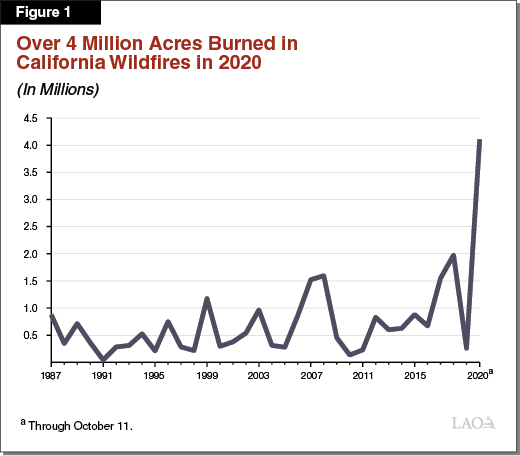
Equally of October xi, most viii,500 wildfires had started in California in 2020. While this is not an unusually high number of wildfires, the number of acres burned in these wildfires far exceeds contempo trends. As shown in Effigy 1, over 4 million acres have burned in wildfires so far in 2020, more than doubling the acreage burned in the side by side worst year of the past few decades (2018).
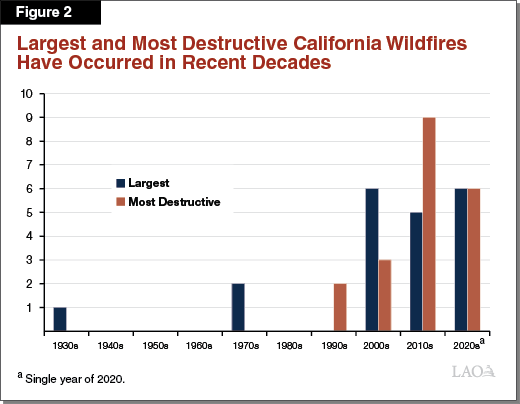
Chiefly, several of the 2020 wildfires have been amidst the largest and nearly damaging since California has begun consistently tracking these statistics in the 1930s. This includes the August Complex burn (Tehama County), which has burned over i 1000000 acres, making it the largest recorded burn in the state's history. The North Complex fire (Butte, Plumas, and Yuba Counties) destroyed almost ii,400 structures, making it the 5th most destructive fire in state history. (The most destructive wildfire was the 2018 Camp Burn in Butte County, which destroyed almost xviii,800 structures.) Effigy ii shows that 6 of the xx largest and 6 of the 20 almost destructive wildfires in the state's recorded history accept occurred in 2020.
As bad as the 2020 wildfire season has been to date, California'southward traditional wildfire flavor is not over. Historically, wildfire season runs through the fall with burn activity affected by factors such every bit rainfall and wind patterns. In contempo years, some big and subversive wildfires—such every bit the Thomas Fire (Ventura and Santa Barbara Counties) in 2017—accept occurred every bit tardily as December.
Administration Now Estimates E-Fund Costs to Exist $1.3 Billion
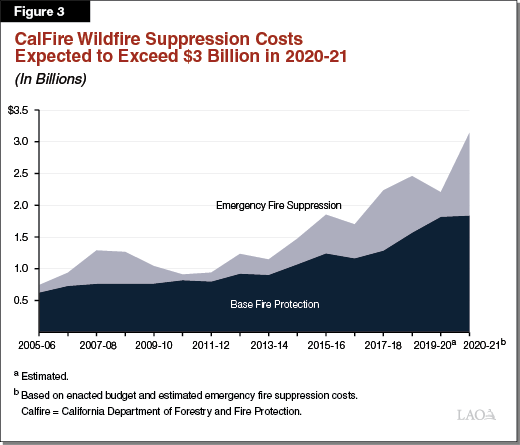
The budget requires CalFire to provide a quarterly study of bodily expenditures from the E-Fund to the Legislature. The written report for the first quarter of 2020‑21 was sent to the Legislature on October 14. According to the study, CalFire spent $893 million from the E-Fund in the first quarter (including the additional $97 1000000 for enhanced baseline resources authorize by the executive society). Based on historical data, CalFire estimates it volition spend an additional $310 million from the E-Fund throughout the remainder of the yr. The quarterly notification also proposes to extend the enhanced baseline resource authorized past the executive society—too as other seasonal staff—through December at an estimated cost of an boosted $97 million. In total, therefore, the administration estimates that the state will spend $i.iii billion from the E-Fund in 2020‑21. This is $928 1000000 higher up the budgeted level. Effigy 3 shows CalFire fire protection costs—including baseline and E-Fund expenditures—since 2005‑06. As shown, based on current E-Fund estimates, full CalFire wildfire protection costs volition achieve almost $3.1 billion. Bodily costs could exist higher or lower depending on wildfire response costs for the residual of the wildfire flavor.
Budgetary Implications
The 2020 wildfire season has taken lives, leveled homes, destroyed habitats, and worsened air quality throughout the state. In add-on, the increased firefighting costs come at a time of recent financial challenges for the state. The higher Eastward-Fund costs are paid directly from the General Fund, thereby drawing down the land'southward Special Fund for Economic Doubtfulness (SFEU), which was budgeted at $2.6 billion. While the purpose of the SFEU is to comprehend unanticipated costs such as wildfires, information technology is important to note that the budget programme already assumed that a portion of the balance in the SFEU would be needed to address the coronavirus affliction 2019 pandemic. (For more data on the state's overall upkeep plan, see our The 2020‑21 Budget: Overview of the California Spending Plan.) Additionally, the 2020 wildfires are likely to consequence in other General Fund costs, including for debris cleanup in affected communities. Given the thousands of structures destroyed, these costs are likely to be in the hundreds of millions of dollars.
Importantly, the state should receive federal funds to encompass well-nigh—usually about 75 pct—of allowable costs associated with burn down suppression for large fires. The federal regime has too canonical reimbursement for recovery-related costs—such equally debris cleanup—for some 2020 fires. In full general, at that place tin can be a delay—sometimes of several years—before these costs are recovered from the federal government, especially for debris cleanup costs.
Ultimately, the 2020 wildfires will consequence in net costs—potentially of a few hundred million dollars—to the Full general Fund, thereby reducing fiscal resource available in 2021‑22. To the extent that the state is in a poor fiscal condition in 2021‑22, these increased General Fund costs will hateful that the Legislature and Governor have to find budget solutions elsewhere, such as through more budget reductions, tax increases, or special fund borrowing. Alternatively, if the state is projected to be in a better financial position in 2021‑22, higher expenditures on wildfires will mean less resources bachelor to contrary actions taken to balance the budget in 2020‑21, such as past restoring cuts or repaying special fund loans, or to support other legislative funding priorities. Our office will release our annual forecast of the Full general Fund condition in November 2020.
Source: https://lao.ca.gov/Publications/Report/4285
0 Response to "2020 Federal Budget for Fighting Forest Fires Cut Again"
Post a Comment